Showing posts with label Angel. Show all posts

Tuesday, July 31, 2018

The Gamble Of The Spin-Off Game


The spin-off has long allowed fans to continue enjoying aspects of their favorite TV shows. Let’s take a look at the clever art of creating a fresh and (hopefully) successful series from a current hit.

To Spin-off or not to Spin-off, that is the question

Your favorite show is winding down. Most main characters have dated each other. A few have died—some even resurrected. And then there were the time jumps…


Pretty Little Liars nemesis pairing for spin-off The Perfectionists.
But the fan base is strong. Lots of subplots and support characters were never fully explored, and the crew work well together. This is where a spin-off is pitched and the network weighs the pros and cons.

All I can taste is coriander

Spin-offs are like perfecting a spice mix. The audience needs familiar flavors blended with new tastes.

Old fans need to feel the series is similar yet different to the original. New viewers need to believe it doesn't matter they haven’t watched the original drama.

Yeah, I'm on it.
The audience cannot be limited to fans of the original show. Being limited to a niche market is a one-way street to early cancellation.

Cult shows and prequel spin-offs

Most spin-offs are either set in the same period or after the original drama but in recent times massive cult hits have produced relatively successful spin-offs by pre-dating a popular series.

Breaking Bad spin-off Better Call Saul is a prequel exploring the history and personal evolution of a character from the popular drama.

This one's funny I swear. So, a zombie and a human walk into a bar...
Fear The Walking Dead is a prequel spin-off to the hit show The Walking Dead. Both deal with different points in the timeline of a zombie apocalypse.

You spin me right round baby right round

And then there are the spin-offs of other hit shows that are happening but haven’t hit screens quite yet.

Popular series Suits is set to have a spin-off called Second City, following the character Jessica Pearson into politics.

I'd vote for her.
Game of Thrones has long seemed a spin-off goldmine due to having, you know, about a million characters. Turns out the first spin-off will be a prequel series.

When the spin-off is too different and you can’t sit with us

Fans were excited to hear of popular series Battlestar Galactica getting a spin-off, and that Caprica would follow the prequel route.

I wasn’t into BG but I really enjoyed Caprica. Most of my friends who loved Battlestar Galactica did not enjoy Caprica.

Caprica dove into consideration of religion and philosophy.
Convincing friends who loved science fiction but did not like or had not seen Battlestar Galactica to watch Caprica proved almost impossible.

Somehow the series’ spin-off status worked against it, and meant the drama ended up being cut off from potential fans.

Messing with a ship

Many viewers become invested in the romantic elements of a drama. Spin-offs have shown the risk of disregarding established or potential relationships.

The Vampire Diaries teased a Klaus and Caroline relationship, yet spin-off The Originals cut the ship short by sending Klaus to New Orleans.
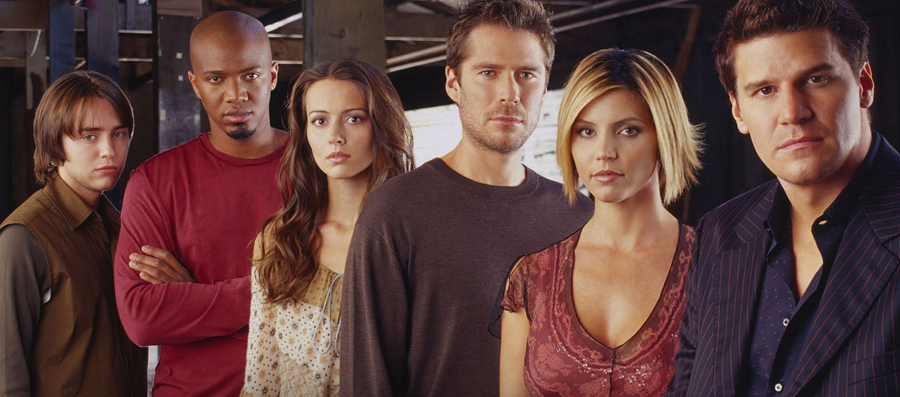
Good times in Angel.
Buffy The Vampire Slayer took a more careful approach and wrote Angel and Buffy into a corner before having Angel depart for LA.

Pretty Little Liars spin-off Ravenswood separated couple Hanna and Caleb, and then compounded the issue with a new co-star slash past life love interest. (Just no.) New Pretty Little Liars spin-off The Perfectionists includes Alison but not her wife Emily, so we'll see how that goes...

When the spin-off gets a spin-off and this is getting meta

The Vampire Diaries birthed The Originals. In that series Klaus has a child with Hayley. Now a new spin-off focusing on Klaus and Hayley’s daughter Hope is in production, called Legacies. The series opts for a school setting, this time a supernatural institute.

Book learnin' the magical way.
Alaric and Caroline set up the school in the series finale of The Vampire Diaries. The character of Caroline isn’t returning as a cast regular. With two shows already it’s a complex backstory. Only time will tell if this angle will work.

Shout out to the best possible spin-off that didn’t get spun

Blogging about spin-offs can’t happen without mention of Supernatural spin-off Wayward Sisters. Dropping this series at the last minute was a television programming mistake on par with the early cancellation of Firefly.

Missed already.
Starring popular female regulars from Supernatural, the characters had complex personal histories full of tragedy and persecution, whose compassion and sense of humor was inspiring. The show already boasted a massive fan base…

…And the CW network pulled the plug at the last minute. Go figure.

Nod to the classics

I don’t think spin-offs can be mentioned without a tip of the hat to arguably one of the greatest combos: Cheers and Frasier.

To think a hit show about a group of regulars at a bar would then birth another massive hit by focusing on the life of one of those quirky characters goes to show what great writing can achieve.

Niles was my dad's fave character.
Despite being almost cancelled in its debut year, the network kept the faith, and Frasier ran for ten more seasons.

Difference between a spin-off and a franchise

Spin-offs follow characters, and a franchise is focused more on shows set in a particular version of reality. Star Trek and it's many shows counts as a franchise. The shows move along the timeline but remain in the same universe (excuse the pun).

Personally I always wanted to see a spin-off that was a Star Trek medical drama. Fingers crossed for that in the future.

The birth of so many memes... 
Recently a new Star Trek spin-off was announced focusing on life for Captain Jean Luc Picard after the events of the series and follow-up films. Yes!

The future of spin-offs

Audience appetite continues to be voracious but patience with new shows is shorter. As platforms expand networks are taking less risks while conversely needing more material.

I'm just sayin', those clone backstories from Orphan Black...
Spin-offs are bound to be in abundance in this kind of entertainment environment. An already present fan base is the go-to for today’s nervous execs. Here’s hoping the fresh brood contain that all-important ingredient for TV success: great writing.


Friday, January 3, 2014

Vamps... The Entertainment Trend That Just Won't Die.


Ah, vampires. I was pretty much a fan from the first time I saw the Count on Sesame Street. I don't think I'm impartial enough to critique the new Dracula television series; the moment Jonathan Rhys Meyers fanged out, I was in. 


I can't really say why I'm a sucker for a blood addict. I know there's a lot of psychological studies linking sexuality and vampirism, but even from a young age, I was primarily fascinated by the concept of time, and of such an impossible incarnation of loneliness; without the degenerative effects of old age, the years would be entirely too crisp, sharp, and unforgettable.

The idea of a person who experiences infinite time is probably the greatest, most fascinating tragedy I can imagine. Remember when a day, a week, even a month seemed eternal? The idea that the body doesn't age and time itself just keeps unfolding forever, is a concept that caught, and held, my imagination. I always thought the potential for isolation, and ennui, was immeasurable for the undead.


Then there's the whole thirst for blood conundrum. To my mind, it's utterly disempowering. The concept of endless life with such a vicious Achilles heel is beyond horrifying; a hunger that overrules judgement (according to the literature) could only lead to a guilty conscience, and/or eventual, eternal, insanity.


Now that's hardcore.


I know a lot of detractors criticise the physical allure of the modern vampire, but I've always been a fan of film and fiction that presents evil characters in truly beautiful physical guises. We have such a primal response to (our own concept of) beauty; we're instinctively drawn to those who possess it. Culturally we reward people for being beautiful, even when our intellect/morals/ethics may argue against such a response.


Making evil people or creatures ugly, in a way that has us flinching from the get go, is almost pathetically obvious. On the other hand, wrapping something potentially dangerous and evil in an aesthetically pleasing parcel adds a whole other layer to the story, because it's almost a perversion of our initial subconscious reading of/response to the individual. 

Making a vampire on television beautiful, so that we're attracted to the character while watching it brutalise people, is much more interesting, especially with the added twist of unwilling empathy. In any form of entertainment, mixed emotive responses are the key to engaging readers/viewers, and vampires offer that opportunity in spades...

I've now decided to wait until the end of the first season of the new series Dracula to really comment on the old guy's latest tv outing. So far I'd consider the program only partially successful, but that's due more to pacing and narrative structure, not to mention some confusing attempts to modernise the female characters in a PC way that should, theoretically, endear them to today's audience, but which fails dismally.

Instead, here's half a dozen television vampires I've enjoyed watching in the past.


What's interesting is tracking the "style" of vampire that appeals across recent decades on television, from the reclusive romantic, to the yuppie slash gangster, to the smooth talking sensual artist, and onto the current sexually aggressive incarnations. A mirror, if you will, into what appeals to the general psyche of the audience at a particular point in time...


Angel in Buffy and Angel


Angel was originally restricted in the sense that Buffy The Vampire Slayer began as a teen-based series, so his dialogue and interactions were "younger".

However, burdening the vampire character of Angel with a psychotic alter-ego Angelus was a stroke of scriptwriting genius. Especially since Angelus was the soulless version of Angel, so the beloved character couldn't be held responsible for the massacres he committed, yet carried the guilt whenever his soul returned to his body.


Transferred to a spin-off program, Angel also became hilariously funny, but it was the scenes with his (relatively) unattainable love Buffy in which the character excelled. By being sexually off-limits, Angel was more of a romantic, existentially-suffering interpretation of vampiredom.


Julian in Kindred The Embraced


This critically slammed Spelling production was actually very interesting in terms of television experimentation. I consider it one of the first attempts to tie American primetime soapie drama for the masses with sexy supernatural allure. I don't think mainstream audiences were quite ready yet, and the writers seemed slightly uncertain how to neatly tie together the macabre and the romantic in a way that wasn't alienating for those with more traditional television tastes, but there were some solid performances in the mix.

The vampire character of Julian is a super-slick businessman so he's more of a buff, Armani-wearing vampire who is savvy with the ways of the modern world. He's also the head of a council of vampires, so he's got a hint of gangster/underworld control to his persona. This is a version of a vampire that tries to tie in the elements of attractiveness found in a mainstream soapie character (ie money/power/worldly success) with more common undead characteristics.


Henry in Blood Ties


Sexual tension is the keystone of many a successful tv couple odd pairing, and Henry and Vicki were no exception. The lore here is that vampires are so territorial they can't stay long in the same place, meaning if Henry turns Vicki to keep her alive forever, he unfortunately won't be able to spend eternity with her. It's a clever conundrum that basically dooms any romance from the start, which makes the show work.

This version of the vampire enters into the Byronesque; artistic, sensual, self-absorbed, clever, jaded, but still in the vein of a nineties television vampire representation, in that he isn't sold as overtly violent; there's more the suggestion of potential aggression held under ruthless control.


Eric in True Blood


On a side note, I consider Sookie Stackhouse to be the dumbest character to ever grace a vampire-themed television show. "Naive" doesn't really translate well onto the small screen. Luckily for True Blood, the vamps in the mix are all pretty fascinating, more than compensating for the troubling series' lead.

This is a colder, more violent, and overtly sexual interpretation of the genre that appeals to today's appetites, and proved a small screen jackpot for the network. Eric and co. encapsulate an uncomfortable primal communion of violence and desire, a leap from the more intellectually-oriented small screen vampire heroes/anti-heroes of the past.


Damon in The Vampire Diaries


What's fascinating about The Vampire Diaries is that it's the meeting place for two modern variations of the television vampire, almost a sociological experiment showcasing changing audience tastes.

The teen-focused program that debuted in 2009 offers two vampire brothers:


-Stefan, similar to Angel/Angelus from Buffy The Vampire Slayer, who is tortured, determined to be good, ashamed of being one of the undead, etc. 

-His brother Damon, a more up-to-date version of mainstream vampire preferences, in that he's a complex sociopath who likes to kill and have sex. A lot...

Damon is undoubtedly the fan favourite O_O And I have to admit, Damon is my favourite too.

In the first few seasons his narrative is interesting, his character multi-faceted, unpredictable... and morally bankrupt. Eventually lost in his own complex mythology and slightly hamstrung by the act of falling in love (but that's a whole other blog for another day), there's no denying that from the first episode, Damon rules the roost.

Comparatively, when you look at Angel from Buffy and Damon from The Vampire Diaries, you see a drastic change in the type of vampire written to appeal to younger audiences.


Dracula/Vlad/Alexander Grayson in Dracula


I've admitted to friends before that I'd basically watch a McDonalds commercial on repeat if Jonathan Rhys Meyers was in it. He's charismatic, yes, but there's almost something twisted about his energy. He gives off a distant yet vulnerable vibe, and is aloof onscreen in a way that somehow simultaneously implies intimacy; basically, the kind of interesting emotional dichotomies great actors excel at projecting. 

 Note to traditionalists: if you're looking for viewing options that stay close to the source material, you might want to skip this incarnation. JRM's Dracula is in cahoots with Van Helsing!

This is a tragic interpretation, and a complex one, since JRM's character actually has three personas in the series. Basically, the network tries to capture elements of previously popular vampire incarnations and present them to the audience in one character mash-up. The blood-drunk lunatic, the tortured romantic, and the powerful, savvy businessman are all in the mix here. The question is whether the approach works.*

(*Will save a further breakdown on this version of Vlad for a Dracula-focused blog.)

Looking at the list above, there's a glaring omission... female vampires. Which I guess provides fodder for the theory there's a strong sexual element to the allure of the vampire, after all. 


(Although it's interesting to note that on the small screen, female vampires are generally offered to the audience in support roles, rather than as lead characters or main love interests.)